Love is a central theme of our lives, yet we learn very little about it in any objective way.
The education of love comes from our own trial and error. It comes from watching our caregivers interact, from Hollywood movies, magazines and media, from the tales of our friends.
Our education about love isn’t really an education at all.
Sternberg’s Triangular Theory of Love
When I first read Sternberg’s Triangular Theory of Love I was like ah ha! It was viewing relationships with new eyes. The framework proposes three factors that when mixed and blended form eight different types of love. Some, more fulfilling than others.
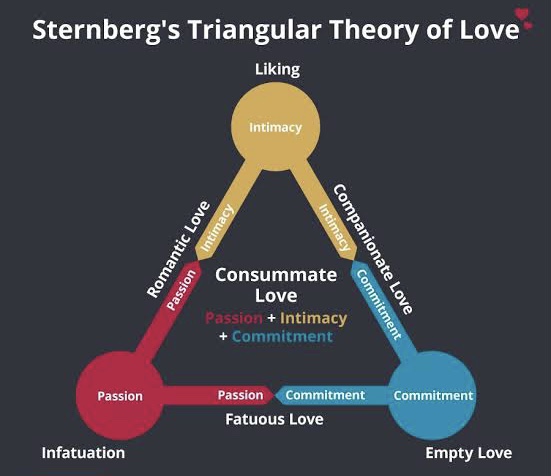
Now, when I talk about love I don’t always mean romantic love. Love is in all our relationships. But for this post I’ll focus on partnership love, the kind where you sail off into the sunset, wear a big white dress and say I do.
Will I be loved, or will I be alone?
Erickson’s life-stages model articulates the challenges we must overcome in each phase of our life as part of how we emotionally mature. Our young adulthood (which comes after adolescence) is about exploring the question “will I be loved or will I be alone”, here enters our good friend love.
How can you unpack that question in a useful way if you don’t understand love.
By the end of your twenties you’ve likely got a grasp that all love is not made equal. But if you had the education to know that a fulfilling relationship will likely comprise of some mix of intimacy, passion and commitment, it might be easier to acknowledge the red flags, and pass on those who simply can’t or won’t give us what we need.
Modern dating is disgracefully difficult. Our culture has taken something so meaningful, the act of finding a partner to grow with, and turned it into a contest. It’s eroded the pillar of commitment.
Commitment is a decision to stay and be in it with someone. We’ve got infatuation, heck we might even have romance. However what’s missing is companionship, someone to walk in the same direction with.
Without commitment we have loneliness.
Maybe if we all started with an emotional education, we could shift how we navigate, experience and talk about our stories and perspectives of love.


 LearnaBee: Thoughtful Growth, One Post at a Time
Leave a comment